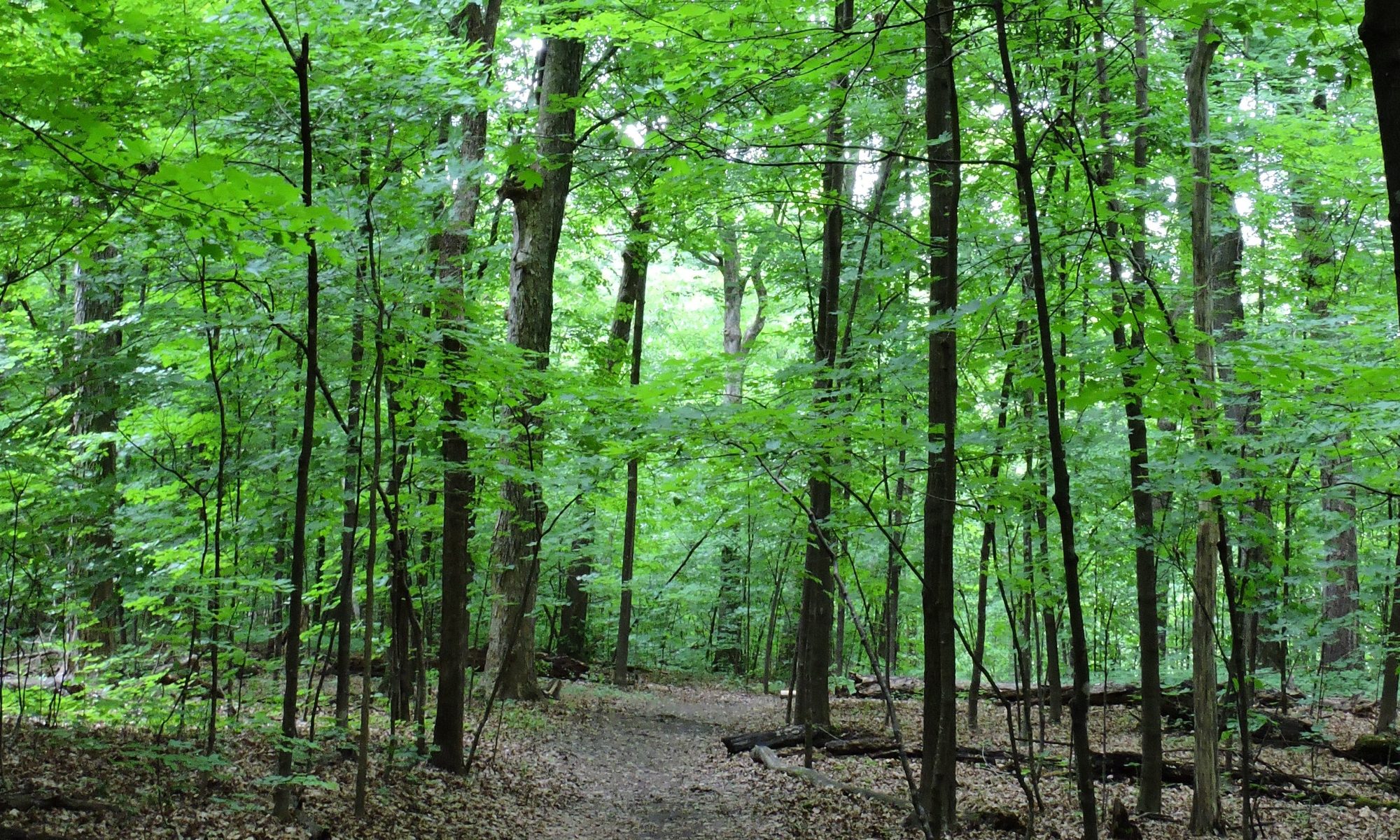
Well, the 7 Day Challenge ended yesterday, and I can honestly say that I spent at least a half hour out of every one of those days outside. Due to work and other commitments, I wasn’t able to wander every day, but just getting out in nature was the primary goal. Since getting out in nature is my primary goal as well, it wasn’t too difficult to meet and exceed the half hour a day minimum requirement!
Mark and I spent several days in our own yard, taking care of some overdue spring chores: raking, trimming, weeding, planting, and pond maintenance. In the 26 years I’ve lived in our house, I’ve been diligent about avoiding adding any harmful chemicals to my yard. When Mark and I married, he was just as adamant that we continue that practice, which has extended to the 
maintenance of the pond we built in the backyard almost seven years ago. So garden weeds are dealt with strictly by hand pulling and digging. The pond receives beneficial bacteria to help maintain the small ecosystem, and occasional barley in the spring to help keep algae blooms from taking over – nothing else is ever added. The pond community seems happy – these two Green Frog friends are two of eleven we have living there this summer. We turned the bottom of the front yard into a rain garden the same year we put in the pond, and it is thriving now, with little help from us other than some weeding. The annual event that, to me, proves choosing a natural yard was the right decision (not that I really need proof, to be honest), is the June arrival of fireflies. When I bought this house, in the early 1990’s, there were no fireflies (lightning bugs) in the neighborhood. A few years later I noticed a few, maybe a half dozen or so at the edge of the woods. From that point on, every year I’ve counted more and more of these fascinating tiny creatures, and today we have hundreds! They glitter among the trees in the woods, give the rain garden an almost Christmassy look, and seem to play hide and seek among the plants surrounding the pond. Watching them is mesmerizing and magical – and I don’t believe they would be here at all if we hadn’t provided a safe environment for them.
One day during the Challenge week, I did have to work all day. But that didn’t pose too much of a problem, as the day was spent outdoors with groups of young children, teaching them about lake and lakeshore habitats. It was such fun, and I’m quite sure I learned just as much as the children did. Before they arrived, I found a water scorpion in the shallows of the lake, and the kids had a great time looking for it – and were all so excited when they finally spotted it!
Two of the Challenge days I joined with a group of songbird banders I’m associated with, assisting with public banding programs. We don’t ever know for sure what we’ll end up with when banding songbirds, but we were kept very busy during both of these programs.  In total we banded 64 birds, including a Black-billed Cuckoo (pictured here), which is a bird many of us had never seen before, and the banders hadn’t encountered at that location in almost 20 years! Quite exciting!
Even though it was a busy week, I did get out to do a little wandering. Mark and I took a walk along the Lake Trail at Carver Park, and spent a bit of time listening to this little House Wren singing away just before we left the park. It was a lovely ending to a  wonderful week spent in the wild outdoors!
 weather! We took the Woodland Trail, which winds along the lakeshore for a good portion of the way and, as advertised, it’s all woodland. The path is primarily grassy, which made a nice change from all the paved trails we’ve been walking lately…although there were one or two areas that we had to navigate due to a little mud (see photo)…
 we spotted, such as Black and White Warblers, Chestnut-sided Warblers, a Mourning Warbler, American Redstarts, Yellow-rumped Warblers, Common Yellowthroats, Blackpoll Warblers, and especially Yellow Warblers, such as the one pictured here.
 several species of sparrow, Red-winged Blackbirds, a Caspian Tern soaring and diving over the lake, a Great-crested Flycatcher, and this handsome Gray-cheeked Thrush.
 folk tale here, other than to mention that it is, apparently, due to Paul’s companion, Babe the Blue Ox, that we owe the 10,000 lakes of Minnesota: Babe’s huge, deep footprints filled with water, giving us the many lakes we enjoy today. By the way… for the record, there are actually 11,842 lakes in Minnesota (bodies of water encompassing 10 acres or more), so evidently Babe really got around! The
  trail stretches from Baxter/Brainerd to Bemidji, and has rich historical significance as well as a wealth of natural scenery, including boreal forests and over 20 of Babe’s lakes. The trail itself follows an old railroad corridor originally built in 1893, and is currently the longest rail-trail in the
 country. The town of Nisswa, where we walked, has an old pioneer town and rail cars that are open to those who are interested in visiting and learning more.
 quiet. Our walk was an early evening amble, and although we met a few local human residents along the trail, we didn’t encounter many other species, at least on the way north. At the point where we decided to turn around to head back, we were greeted by an Eastern Phoebe, pictured here, but it was a short greeting and we were
  left alone again quite quickly. The point we chose to turn back was at the channel between Nisswa Lake and Lower Cullen Lake, and from this spot there is a view of both lakes. Lower Cullen Lake is close by and the perspective from the trail is serene, one can see much of the lakeshore through the trees. Nisswa Lake is on the opposite side of Highway 371, so there is some traffic noise, but the many trees do a good job of muffling those sounds, and the lake can be glimpsed beyond the highway. We lingered here, enjoying the sounds of the rushing water in the channel, as well as the warmth of the sun as it neared the western horizon. It’s a lovely spot, along a very beautiful trail.
 Clay-colored, and Chipping Sparrows, with a couple of American Robins joining in. They were all busily foraging for their last meals of the day, as the sun was beginning to set by then. We wandered slowly past them. It had been a busy day and Mark and I were both tired, but it was such a peaceful walk we didn’t want it to end. I would like to take in more of the Paul Bunyan Trail at some point – my guess is that most of the trail is just as lovely as the small portion we experienced this week!
 and spotted what looked like a brilliant spark of flame in the branches of a fallen tree. It turned out to be a male Baltimore Oriole, the first we’d seen so far this year. He was very intent on foraging among the branches of the tree, and paid no attention to us whatsoever. His vivid breast blazed alternately a deep orange and a radiant gold. Quite a striking bird, wouldn’t you agree?
 remained invisible to us, which was pretty much expected. However, I did get some glimpses of a couple of Green Frogs, such as the one I photographed here.
 by looking at trees. I thought these two trees in particular were fascinating… one looks to me like a group of dancers, all pointing slipper-clad toes in a close, graceful group. The other is a scar, with an arresting design where the tree healed.
